LXXXVI DLXXIV 87739122


.jpg) By: Ethan
By: Ethan
A standardized footprint, a few practical depths, and one material decision that changes everything. Here is what "1/4 tray size" really means on a food-packaging specification.
A catering kitchen at six in the morning: the prep cook slides a quarter tray of marinated chicken into the cold rail, labels it, and rotates the inventory by day. Later, the same tray is sealed, transported, reheated, and served from a stainless counter well without the product ever being transferred. That is the quiet logic of the quarter tray — it fits every piece of equipment in the chain because the whole industry built around the same standard.
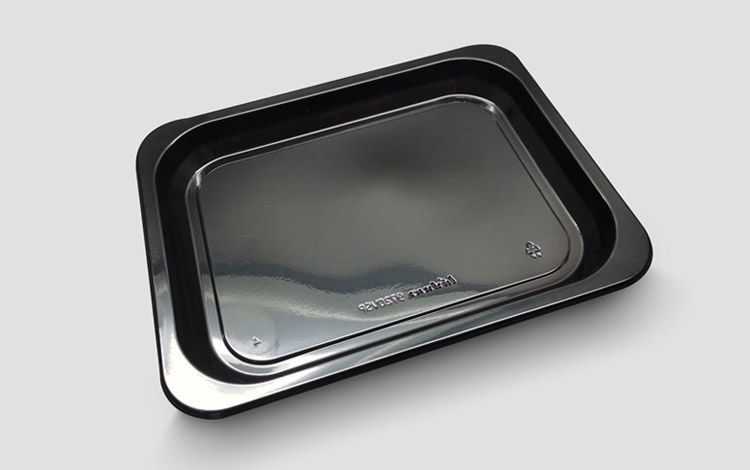
The 1/4 tray size measures about 10 3/8 by 6 3/8 inches (264 by 162 mm) at the outer rim, and its usable volume is set almost entirely by depth. A 4-inch-deep quarter tray holds roughly 4 quarts (3.8 L); a 2.5-inch version holds about 2.5 quarts. The format belongs to a family of food-service tray standards that begins with the full-size pan and divides into halves, thirds, quarters, and sixths — a hotel-kitchen convention that still shapes how disposable plastic trays are sized today.
The full-size pan is the master footprint: about 20 3/4 by 12 3/4 inches (527 by 324 mm). Divide that footprint by halves and you reach the main formats used in refrigeration, display, transport, and service. A quarter tray follows directly as the child of a half tray, with outer dimensions around 10 3/8 by 6 3/8 inches — small enough to manage with one hand, large enough to hold a real service portion.
Two tolerances matter when you source plastic quarter trays. The inch figures describe the top outside edge, while the internal usable area is smaller because thermoformed trays taper inward toward the base — usually around 4 degrees — which also lets them nest for shipping. A European supplier may label the same footprint as Gastronorm 1/4 (about 265 by 163 mm). The systems are close but not interchangeable in a tight rail, so always confirm the top-outside dimensions with the manufacturer.
For readers coming from a bakery background, note that a quarter sheet tray is a different format entirely, starting around 13 by 9 inches. The food-service 1/4 tray discussed here is the much smaller hotel-pan footprint.
As with most standardized food-service formats, the nominal inch measure describes the top outside edge. The internal surface area your product contacts is always a little smaller — often by half an inch or more across each dimension.
| Format | Outer length | Outer width | Typical depths | Volume at 4 in depth |
|---|---|---|---|---|
| Full (1/1) | 20.75 in (527 mm) | 12.75 in (324 mm) | 2.5–8 in (64–203 mm) | ~16 qt (15 L) |
| Half (1/2) | 12.75 in (324 mm) | 10.38 in (264 mm) | 2.5–8 in (64–203 mm) | ~8 qt (7.6 L) |
| Third (1/3) | 12.75 in (324 mm) | 6.88 in (175 mm) | 2.5–8 in (64–203 mm) | ~5.3 qt (5 L) |
| Quarter (1/4) | 10.38 in (264 mm) | 6.38 in (162 mm) | 1.6–8 in (40–203 mm) | ~4 qt (3.8 L) |
| Sixth (1/6) | 6.38 in (162 mm) | 5.84 in (148 mm) | 2.5–8 in (64–203 mm) | ~2.7 qt (2.5 L) |
| Ninth (1/9) | 6.38 in (162 mm) | 4.25 in (108 mm) | 2–6 in (51–152 mm) | ~1.8 qt (1.7 L) |
Once the footprint is fixed, depth becomes the entire capacity story. For a quarter tray there is a useful shorthand: the capacity in quarts is roughly equal to the depth in inches. A 4-inch-deep tray is a 4-quart tray; a 6-inch-deep tray is a 6-quart tray. The relationship follows from the footprint being exactly one-quarter of the full-size base, and it makes production planning straightforward.
| Depth | Approx. capacity | Common use |
|---|---|---|
| 1.6–2 in (40–51 mm) | 1.6–2 qt (1.5–1.9 L) | Condiments, garnishes, tasting portions |
| 2.5 in (64 mm) | 2.5 qt (2.4 L) | Side salads, sauces, prepped toppings |
| 4 in (102 mm) | 4 qt (3.8 L) | Proteins, dairy, deli counter display |
| 6 in (152 mm) | 6 qt (5.7 L) | Marinades, bulk prep, high-yield storage |
| 8 in (203 mm) | 8 qt (7.6 L) | Deep storage, large-batch production |
Depth also changes logistics. Deep quarter trays nest less efficiently in a shipping box and take longer to pull down to safe storage temperature. When a truck moves large volumes, two shallow trays are often the better specification than one deep tray, because the same total volume cools faster and gives you two independently labelled lots.
The dimensions tell you what fits; the material tells you what the tray can survive. The main disposable families are crystallized PET (CPET), clear PET, polypropylene (PP), and barrier structures using EVOH. Each one changes the temperature range, the sealability of the film, and the cost per portion.
CPET is the first choice when a tray must go from freezer to oven or pass through a catering retherm cycle. The crystallized structure stays rigid hot and does not turn brittle cold, which is why ready-meal and airline-catering operations rely on it. If your 1/4 tray will be reheated, confirm the upper temperature rating rather than assuming a generic PET can handle it.
Clear PET and PP cover the cold chain. Amorphous PET gives clarity for a display counter but is not meant for baking; PP resists oils and acids and suits sauces, curries, and prepped vegetables. So tray selection is really a question of the full journey — chilled display, reheating appliance, sealing station — not just the footprint.
For fresh proteins, the barrier layer is the real variable. EVOH is an oxygen-blocking layer inside the tray wall that slows spoilage in modified-atmosphere packaging. A quarter tray with EVOH extends the display life of meat, poultry, and sliced deli items far beyond plain PET, because the side walls themselves stop oxygen from entering. The trade-off is cost and a different recycling stream, so the decision should follow the target shelf life.
Structural rigidity matters too, especially for heavier items and repeated handling. Turned-edge trays, with a rolled or folded rim, gain stiffness without adding wall thickness. They resist bowing under heavy loads, stack reliably on conveyor or crate, and give lidding film a clean sealing edge. For catering loads that travel, this is often what separates a tray that survives the trip from one that arrives distorted.
Treat the tray as part of a system: film, sealing settings, and distribution temperature all interact. Since no material works for every food, it pays to review the fundamentals — choosing a tray format according to the food protects yield and shelf life more reliably than any universal tray.
The quarter tray earns its place through portion control, equipment compatibility, and throughput. Because the footprint is identical across cold rails, display cases, and heated wells, the same plastic tray moves from prep to service without re-portioning. The format delivers the most value in these roles:
The quarter tray is small enough to control cost, and large enough to matter. Most food-service operations discover its value when they try to replace it with an undersized generic alternative.
Ordering by "1/4 tray size" alone is not enough. Suppliers put different tapers, depths, and rim designs under the same name, and the differences show up on your line. This checklist removes the surprises:
At our packaging facility in Ningbo, food-contact tray production runs under HACCP- and BRC-based systems, with in-house mold design and development. Every quarter-tray project starts from these specifications rather than assumptions — for a format standardized for a century, the details still decide whether it works.
The 1/4 tray size looks unremarkable on paper — about 10.4 by 6.4 inches, a few quarts, a few grams of polymer. In practice, it is the format that lets a kitchen prepare, store, display, and serve the same portion without re-handling it. The dimensions are standard; the performance is not. Confirm the footprint, match the material to the temperature and barrier requirements, and the quarter tray becomes one of the most dependable elements of the entire packaging operation.
.jpg?imageView2/2/w/600/h/600/format/webp/q/75)
A standardized footprint, a few practical depths, and one material decision that changes everything...
Food Service Packaging Field Guide Coffee Cup Dimensiones: Mensurae post solatium...

LXXXVI DLXXIV 87739122
Copyright © Ningbo Linhua Plastic Co., Ltd. All Rights Reserved.


Post Comment