LXXXVI DLXXIV 87739122


.jpg) By: Ethan
By: Ethan
Packaging Materials — A Buyer's Briefing
Where plant-based trays genuinely perform, where they quietly fail, and how a tray manufacturer reads the material list before the marketing claim.
A chilled ready-meal brand we advised last year brought us two quotes for the same single-compartment tray. The first was bagasse, marketed as fully biodegradable. The second was a PET base with a moisture-retention structure. The line that would run either option seals lidding film at around 165°C, fills a warm sauce, and promises retailers 18 days of chilled shelf life. The greener-looking quote would have won the meeting — and lost the season on a deformed tray.
The short version: biodegradable food trays are a strong choice for dry and short-life foods, food-service ware, and markets with working composting collection. They are a weak choice for long-life chilled protein, hot-fill, and high-barrier applications, where recyclable high-barrier plastic remains the engineering answer. The rest of this briefing shows you how to tell which side your product falls on — and how to buy well either way.
Biodegradable means microorganisms — bacteria and fungi — can break a material down into water, carbon dioxide and biomass. On its own, the word carries no deadline, no temperature and no test. Compostable is the enforceable subset: a certified compostable tray must disintegrate within 12 weeks and convert at least 90 percent of its mass to CO2 within six months under industrial composting conditions of roughly 58°C, according to the European EN 13432 standard. ASTM D6400 sets the equivalent bar in North America.
That distinction decides everything downstream. A tray can be technically biodegradable in a landfill over decades and still fail every certified standard you could print on its label.
InfoAsk for the certificate, not the adjective. EN 13432 and ASTM D6400 are the two documents that turn a material claim into a procurement document. If a supplier cannot show one of them, the tray is only biodegradable in the sense that everything is, eventually.
Five material families dominate the category, and each behaves differently once it meets real food, real heat and a real sealing jaw. Our own material library spans PP, PS, PET, CPET and PLA, so we tool and produce both the compostable and recyclable routes — the table below is the first-pass conversation we have with buyers before any quote goes out.
| Material | Typical Best Use | Heat Ceiling | End-of-Life Route | Main Watch-Out |
|---|---|---|---|---|
| Bagasse (sugarcane fiber) | Deli, catering, dry-to-moist service ware | Around 100–120°C; microwave-safe grades exist | Industrial composting | Wet strength; grease barrier must be PFAS-free |
| PLA (plant-based plastic) | Cold deli, salads, clear lids | Softens near 50–55°C | Industrial composting | Deforms under hot-fill or heat lamps |
| CPLA (crystallized PLA) | Hot service ware and lids | Around 85–100°C | Industrial composting | Higher unit cost; not crystal-clear |
| Paperboard with barrier coating | Bakery, deli, tray-presented meals | Limited by the coating | Depends on the coating | Seam leaks; coating decides compostability |
| Bamboo, palm leaf, wheat straw | Premium catering and events | Good dry heat | Home or industrial compost | Size variation; supply consistency |
| PET / CPET (recyclable counterpoint) | Ready meals, frozen, oven-ready | CPET to around 200°C | Recycling stream | Not biodegradable; needs a working recycling stream |
Two notes worth pausing on. First, bagasse is rigid and heat-tolerant, but wet strength and grease resistance depend entirely on the barrier treatment — ask specifically for a PFAS-free grease barrier and test it with your wettest SKU. Second, standard PLA is crystal-clear and genuinely plant-based, yet it softens near 50–55°C, which a hot cabinet or a warm sauce can reach without effort.
The best-fit profile is consistent across the projects we see: short shelf life, dry-to-moist food, moderate heat, a customer who actually sees the tray, and a city that actually collects compost. When those boxes tick, the premium — typically 10–30 percent over a PET equivalent, depending on resin markets and volume — buys visible brand equity rather than mere compliance.
SuccessStrongest-fit scenario: a catering, deli or event operation serving within 24–72 hours, in a region with commercial composting collection, where the tray is part of what the customer photographs.
Standard PLA deforms near 50–55°C; CPLA pushes the ceiling to roughly 85–100°C at a higher unit cost. Bagasse survives ovens and microwaves but turns fragile when its grease barrier is cheap or missing. Most grades freeze fine, but freezing is the easy half of the journey — reheating is where trays fail in front of customers.
WarningStandard PLA starts to soften near 50–55°C — a heat lamp, a hot cabinet or a warm sauce can reach that easily. If your product journey includes a heat lamp, test the tray under the lamp, not in the meeting.
Compostable materials generally offer narrower heat-sealing windows than PET or PP, which shows up as slower line speeds or higher leak rates when film and tray are sourced separately. We develop tray and film together for exactly this reason: the seal, not the material label, is where a material switch actually succeeds or fails.
A compostable tray is only as green as the collection system underneath it. Where industrial composting is scarce, the claim evaporates — and worse, it can contaminate the streams that do exist.
DangerA PLA tray dropped into a PET recycling stream is a contaminant, not a benefit. Match the tray's end-of-life route to the collection system that actually operates in your market — or choose a material that fits the stream your city already runs.
Beyond the 10–30 percent unit premium, expect longer lead times for certified material, minimum order quantities that punish small runs, and price movement tied to agricultural resin markets rather than oil. None of these are deal-breakers; all of them belong in the cost model before the first pallet ships.
Some products simply need more than a compostable tray can hold. Long-life chilled protein under modified atmosphere, vacuum-skin packs, frozen poultry, oven-ready meals — these live or die on oxygen and moisture barrier, and that is the territory of engineered plastic structures rather than plant fiber.
For frozen chicken and other long-freezer proteins, an EVOH barrier tray is the honest workhorse: an oxygen barrier measured in laboratory numbers rather than in slogans, with shelf life to match.
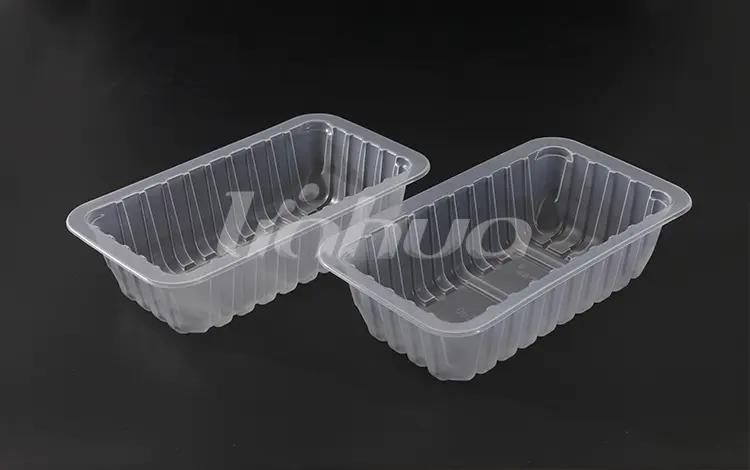 LP9560 High-Barrier MAP Tray for Frozen ProteinsA polypropylene MAP barrier tray (226×134×50 mm) sealed with barrier lidding to lock out oxygen and leaks. Positioned here as the reliable shelf-life workhorse for long-freezer chicken and other frozen proteins.View Product →
At the fresh meat counter, purge control decides whether the pack looks premium or tired; a moisture-retention PET base keeps liquid away from the film and the label.
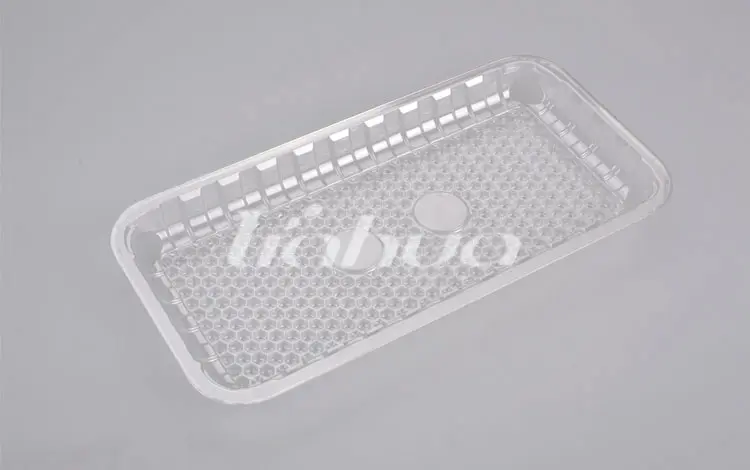 MRT511 PET Moisture Retention TrayA PET moisture-retention tray (288×145×25 mm) that keeps purge away from film and label so fresh meat packs look clean and premium at the counter, not wet and tired.View Product →
And for ready meals that travel from freezer to oven, CPET remains the tray that takes both — dual-oven stability from -40°C to around 200°C, with recyclable PET behind it.
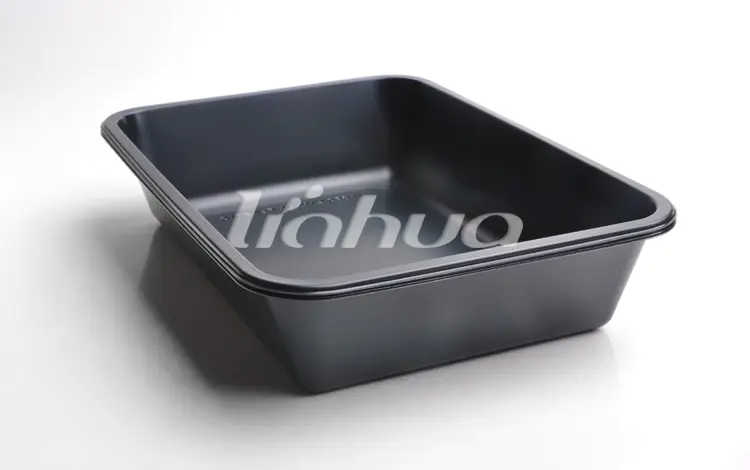 CPET TRAY-1 Dual-Oven Ready Meal TrayA CPET tray (215×156×46 mm) with dual-oven stability from -40°C to around 200°C and recyclable PET behind it — the fit for ready meals moving straight from freezer to oven.View Product →
Sustainability, in other words, is not a single material decision. Lightweighting, mono-material design and genuine recyclability carry their own environmental weight — this breakdown of how EVOH barrier trays address environmental sustainability in packaging is a fair starting point if you are comparing the two routes on evidence rather than adjectives.
Run any tray decision — biodegradable or not — through the same six steps:
A tray is judged twice — once in the buying meeting, and once under a heat lamp at 11:40 a.m. Only one of those rooms has read the certificate.
Match the material to the shelf life and the line first, and to the story second. Biodegradable food trays are a real, certifiable answer for short-life, front-of-house food service with composting behind them; recyclable high-barrier systems remain the correct answer where shelf life, freezing or oven travel decide the purchase. The greenest tray is the one that protects the food, survives your line, and exits through a stream your city actually operates.
That systems view is also the logic behind our zero-carbon commitment. If you are weighing the two routes for a specific product, send us the temperature journey and the shelf-life target — quoting compostable and recyclable options side by side is the part of the job we enjoy most.
.jpg?imageView2/2/w/600/h/600/format/webp/q/75)
Packaging Materials — A Buyer's Briefing Biodegradable Food Trays: An Honest Briefing Before You Sw...
.jpg?imageView2/2/w/600/h/600/format/webp/q/75)
Polietilene tereftalato, vel polyethylene terephthalate ut Anglice scribitur, uni chemicae for...

LXXXVI DLXXIV 87739122
Copyright © Ningbo Linhua Plastic Co., Ltd. All Rights Reserved.


Post Comment